Ballistics update in homicidium
Advanced Projectile System (APS)
homicidium is supposed to hit like Doom and shoot like a real gun, and those two goals fight each other. Hitscan is fast but feels fake. Full realistic exterior ballistics is accurate but too heavy to run at combat speed with a room full of projectiles in flight. APS is our answer: a home-grown system built to be semi-realistic while staying fast enough for fast-paced gameplay.
What it does today
- Ballistic coefficient calculations for drag — how fast a projectile slows down in flight, per-round rather than a flat falloff curve
- Realistic trajectories — real drop and flight time instead of a hitscan ray
- Penetration based on projectile velocity and impact material density
Penetration and yaw
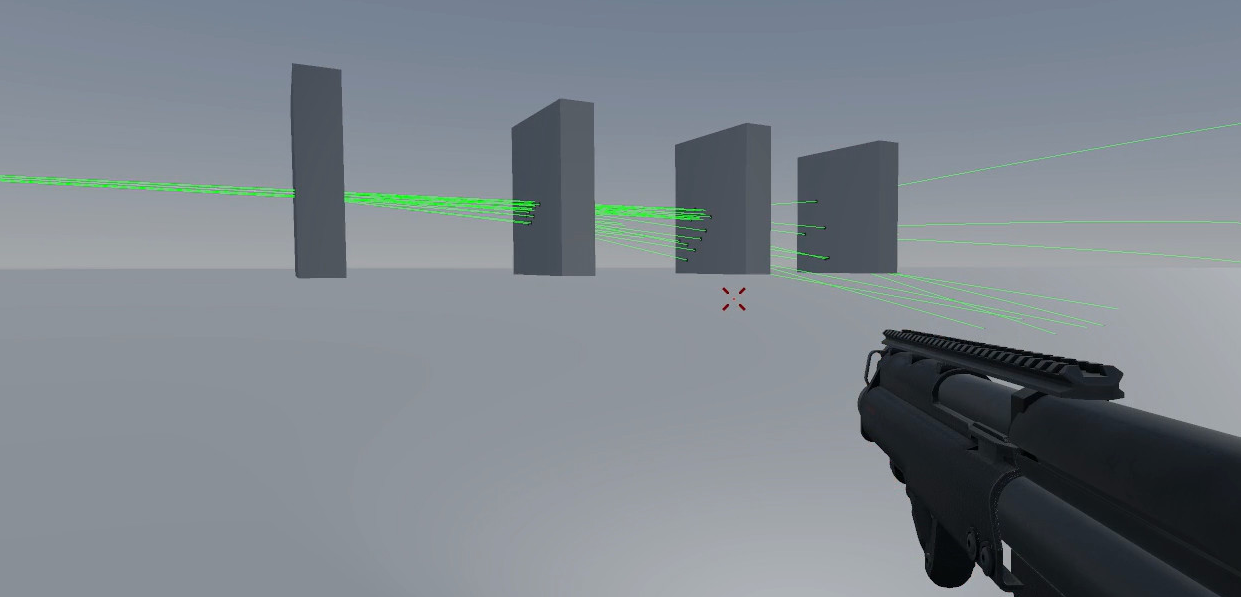
Whether a round penetrates an object comes down to velocity vs. that object’s density. When penetration does occur, the round’s course gets thrown off based on that density — simulating yaw after passing through a hard object, the same way a real bullet tumbles or deflects after punching through something it wasn’t quite fast enough to shrug off cleanly. Velocity drops too, by an amount dependent on the projectile’s weight and the material’s density — heavier rounds retain more speed through the same obstacle than light ones.
Test case: four panels, one shot
The sample below is a point-blank shot of 00 buckshot at 1350fps passing through four objects, each with a density of 5. Each passthrough adds spread — the pellets scatter a little more with every object they punch through — while velocity drops hard each time. By the fourth panel the projectiles were down to roughly ~100fps, which is non-lethal territory. That’s the system working as intended: penetration has a real cost, and buckshot doesn’t stay buckshot forever once it starts eating cover.
What’s next
APS gets open-sourced once it’s done — the goal has always been to give the rest of the realistic-ballistics-in-games crowd something better than a lookup table to build on.